A teacher’s perspective: NYSED Learning Summit

I have found that one of the best parts of being a public education activist is having the honor of meeting so many amazing people from across the state.  The fight against the harmful agenda that has been enacted in New York State has allowed me to meet some incredible people from places like Buffalo, the Capital District, the Hudson Valley, and many other locations in our state.  However one of the most intelligent, articulate, and passionate people who I have had the pleasure of being in this struggle with is one of our very own PJSTA members, Melissa McMullan.  Surely her colleagues at JFK Middle School have long known what I have learned about Melissa over the past year and a half.  She is a tireless advocate for our students and a remarkable representative of our profession.

Melissa (@Refusethetests for those of you on Twitter) was able to procure an invite to yesterday’s NYSED Learning Summit that dealt with teacher and principal evaluations.  She was able to write up for us her experience.  It is a fascinating read…

Last week I learned about NYSED’s Learning Summit, that was to be held on May 7th in Albany, in order to discuss implementing the new teacher evaluation system as prescribed by the New York State Education Law enacted on April 1st with the passage of the New York State budget. This “budget” requires that student growth measures account for 50% of a teacher’s evaluation, with the remaining 50% comprised of observations (part of which would be outside observers). The law wrapped within this budget also ostensibly eliminated permanent certification, and now makes not reporting an address change to NYSED and “actionable offense” much like a sex offender. When Newsday called this a public forum, I immediately wanted to know which members of the “public” were invited. I could not find anyone. So I did the only thing I could think of, I emailed the Board of Regents, and requested an invitation.

I received no response – until three days ago. Regent Rosa emailed a response stating that she would forward my request to the appropriate party. The next day I received a response from the Board of Regents’ Secretary stating that invitations had been given to the appropriate stakeholders, there were no seats available, and I could certainly watch the event via simulcast. That night, livid, I fired off a response that indicated it was no surprise, and that, at the very least, we, as teachers, have been consistently shut out from the very process that centers upon our own work.

Wednesday, at 11:44am, I received a response from the Board of Regents’ Secretary, it read, “A seat has just become available and is available to you. Please let me know at your earliest convenience if you will attend.” Elated, I scrambled to write lesson plans for the following day, and gather my family for the four-hour drive north to Albany, searching for a hotel room as we drove. We have been in this fight for a long time. It has been nine years for me. We are not going to win back public schools for our children, without approaching from every angle and understanding the variety of positions.

Today I spent the day, as the special guest of the Board of Regents. It turns out that both Regent Cashin and Regent Rosa were fighting very hard for me to be there. The first thing I learned today, and I learned a lot, is that in general, the Board of Regents is remarkably supportive of teachers, and more importantly, the students we love so dearly. Throughout the day, I was able to hear from superintendents, principals, researchers, teachers, parents and school board members about their varying perspectives on teacher evaluation in New York State. It was an eye-opener.

An overwhelming theme today is the understanding that the New York State 3-8 assessments are flawed. It is undeniable. There is no reliability and validity testing on these tests. Furthermore, they simply were not designed to measure a child’s growth from year to year. A teacher’s growth score is actually based upon how that teacher measures against similarly situated teachers (students with the same socioeconomic class / ability). This means, every year, the distribution follows a normal distribution of scores within each group. Thus, even if every teacher in a group of similarly situated students helped their students show incredible growth, the model requires that some of those teachers are high, the majority is in the middle and some are at the low end. So we have state assessments that at best have never demonstrated reliability and validity (at worst they are developmentally inappropriate), and those assessments are being used to drive an ill-fated teacher evaluation system.

Most panelists agreed that the best component of the teacher evaluation system is teacher observations. When done right, it provides a continuous feedback loop that could ostensibly improve instructional practice. Panelists had some incongruous thought on the outside observer as prescribed by the new law. Some believe it helps provide more objectivity. However, many noted the challenge in time and money this would cause school districts, as well as the potential ineffectiveness of a teacher being observed by a stranger who would not have the kind of relationship with him / her that would support a dialogue that would improve instructional practice.

Aside from the obvious aforementioned issues with the growth score, the much larger issue is the lack of integrity of those scores. Regent Cashin brought up the fact that the American Statistical Society asserts that a teacher can vary a student’s score by 1-14%. Stephen Caldas from Manhattanville College explained that in the state’s own reporting, you will find statistical error of these scores in the 55% range in some areas. This begs the question – what, then, is the value, if any, of the state growth score in measuring teacher performance? Do we have the right to call a teacher ineffective with his tool?

What was most striking to me as a teacher was my own panel when it was introduced. Every other panel filled all six seats at the front to maximize the perspective of each particular group of stakeholders. When teachers were announced, two people went up, Michael Mulgrew, UFT President and Catalina Fortino, NYSUT vice-president. In dismay, I watched as Mr. Mulgrew had his teachers stand up in the audience, but he brought no active classroom teachers forward to discuss their needs in the APPR process. And this is what has been going on for some time. NYSED will say, “we invited them”, and I can say in this case they did, but our own union silenced us.

Those of us like me, the 200,000+ parents who refused to permit our children to take the state assessment made a tremendous impact on the Board of Regents and NYSED. It is very clear that they got the message; we know the assessments are not valid and you will not use our children in this fraudulent practice. Lisa Rudley, from NYSAPE, actually quoted Dr. Rella and said we must ask ourselves “Are the kids okay?”

Lastly, many New York State Assembly members were present. Barbara Lifton, New York State Assembly 125th district, was seated behind me. During a break, she eagerly told me she was present to advocate for teachers. I asked her if she had voted in favor of Cuomo’s budget, and she indicated she had, specifying that she did not want to, but she had no other choice. I emphatically told her a number of times that she caused irreparable harm on teachers and school children. She insisted there was no choice. When I mentioned different aspects of the law, such as notifying NYSED of address changes to avoid being treated like a sex-offender, she appeared shocked, as if this were the first time she heard this. Based upon my conversation with her, it is clear, she did not read the law before she passed it. Claiming that she is advocating for us now is like telling me you are going to find me a good doctor after you broke my leg. We must remain steadfast in holding every single legislator who voted in favor of this budget and its laws responsible for what they did by making sure they do not get re-elected.

In closing, I sat at the Learning Summit with tremendous guilt because I fought for a “golden ticket” and won, while most did not find themselves so lucky. However, I can say in total, this was one of the best days of my career. I sat with the Board of Regents the entire day, and I was given substantial time to share our plight as teachers, and the impact all of this is having on our students. I was also able to speak with Chancellor Tisch alone for several minutes, and explain soup to nuts what had transpired in Comsewogue when our district wanted to contemplate not administering the assessments (yes, the threat to fire the superintendent and entire locally elected board). I explained that we have no use for the current student assessment system, and because of our love and dedication to our students, we are seeking Middle States Accreditation and our own standardized testing that can actually be used to inform instruction.

Teachers, we are on the right track. Mulgrew said we must take back public education. We are in this mess because we allowed outsiders to craft policy for our classrooms. Enough is enough. It is becoming increasingly transparent that all of the deforms they have created are a bust. We cannot allow them to harm our students by permitting them to erode the best practices that we know work. Do not be discouraged. We made tremendous headway by being honest with parents about what we know about the fallacies of the state assessments. We need to continue on this path. Forcing children to take tests for innumerable hours that will only tell NYSED how one teacher fairs against another is an egregious misuse of classroom time. Refusing to allow it will be the undoing of all that has come to pass threatening to decimate public education.
Who is the Stronger Together Caucus?

Anyone who paid attention to the news coming out of the NYSUT RA which was held this past weekend in Buffalo, likely heard of the standing room only crowd in the Stronger Together Caucus (STCaucus) meeting.  As a matter of fact I had several delegates approach me and tell me that the caucus meeting was the highlight of the entire RA for them.  Approximately 500 NYSUT delegates, representing locals from all corners of the state, registered as members of the caucus.  On Sunday, following the RA, membership in the caucus was opened up to all NYSUT members, whether they be delegates or not.

If you are not a NYSUT delegate you may be wondering exactly what a caucus is and why you should consider joining STCaucus.  I’ll attempt to answer those questions for you in this post.

By definition the term caucus means “a group of people with shared concerns within a political party or larger organization.”  Within many of the larger unions in the country, whether they be a local representing teachers in a specific city or a statewide union like NYSUT, caucuses exist.  Quite often these caucuses represent different visions and philosophies for how their union should be governed.

Prior to this weekend, NYSUT has always been a union dominated by one caucus, the New York State Unity Caucus.  At the state level Unity Caucus is an outgrowth of the UFT Unity Caucus in New York City which is an invitation only caucus in which all members sign an oath to vote as their leadership instructs them to vote.  It is an exclusive club which severely impairs democracy within the UFT, NYSUT, and the AFT whose largest voting contingent is made up of NYSUT delegates.

There are very fundamental ways in which STCaucus differs from Unity Caucus.  The first, most basic way is STCaucus’ mission to create a more democratic union that is inclusive in nature and truly representative of it’s members.  This can be demonstrated by one of the amendments that STCaucus authored for consideration at this year’s RA.  The amendment would have had NYSUT elections take place through regional voting.  NYSUT delegates from around the state would vote at their local regional offices, rather than at the RA.  The amendment was created because only about 30% of NYSUT locals participated in the last NYSUT election.  One of the primary reasons being that many small locals from across the state simply cannot afford to send their delegates to stay at the New York Hilton in Manhattan where the elections are held.  The amendment would have allowed for more locals to have had a say in the election, thus furthering democracy within the union.  Unity Caucus came out against this amendment and helped to vote it down.

Another fundamental difference between the caucuses are their leaders.  Most of, if not all of the members of the STCaucus Executive Committee are currently classroom teachers.  For example. committee chair Beth Dimino is currently an 8th grade science teacher in the Comsewogue School District.  Compare that to the current NYSUT officers, or the UFT’s Mike Mulgrew or Leroy Barr, all influential within Unity Caucus at the state level.  Most of those individuals have not seen a classroom in years.  Being disconnected from the classroom, while limiting who is permitted to be a part of your caucus is no way to get the pulse of where our members stand on the issues important to our profession.

Arthur Goldstein, the blogger who runs the NYC Educator blog, recently asked me to write a piece for him on the significance of the development of the STCaucus.  That was published yesterday over at the NYC Educator blog.  I also re-published it here.  I encourage you to give it a read as it has a more detailed look at how STCaucus impacted the NYSUT RA this past weekend and it’s potential impact going forward.

You can join STCaucus by printing out this registration form and mailing it to the address at the bottom of that form along with a $10 check.

STC
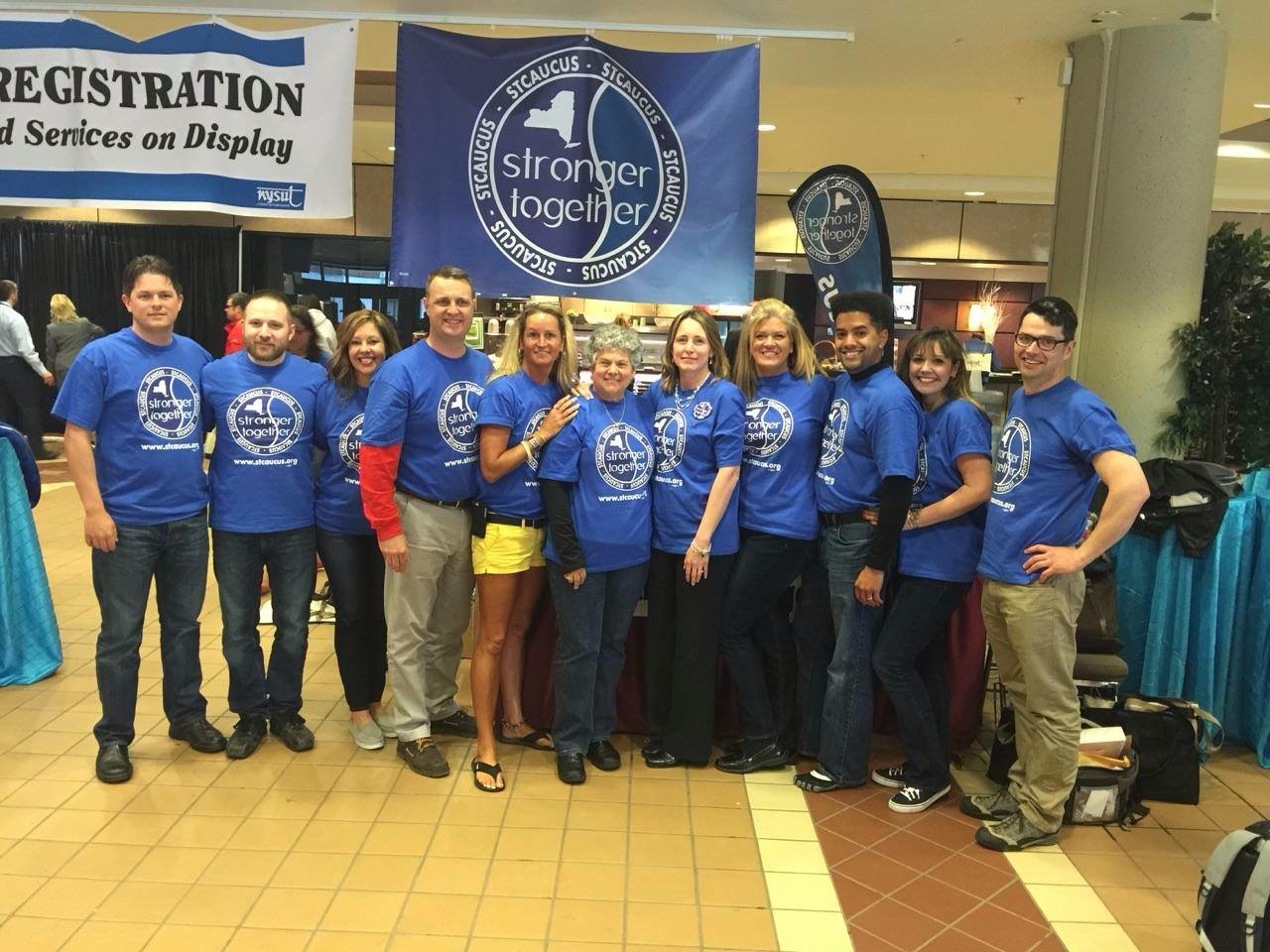
STCaucus Executive Committee- Joe Karb, Nate Hathaway, Laura Spencer, Kevin Coyne, Angelee Hargreaves, Beth Dimino, Michele Bushey, Beth Chetney, Orlando Benzan, Megan DeLarosa, Mike Lillis Not pictured: Mike Schirtzer

ST Caucus Brings Real Grassroots Unionism to NYSUT

Blogger Arthur Goldstein, who is the primary writer for the blog NYC Educator, recently asked me to write about the significance of the STCaucus within NYSUT.  Here is what I wrote, originally published at NYC Educator…

Every now and then I have one of those moments in life where I just know that I am in the midst of something historic, something important, something special.  A moment where I am certain that a course has been forever altered.  Activists like myself live for these moments.  These moments are the positive affirmations of the endless hours of work we have put into a cause.  They are the fuel that keeps our tank running, pushing us onward in our journey for positive change.  This weekend, at the 2015 NYSUT Representative Assembly in Buffalo, I had one of those moments.

The membership registration drive followed by the inaugural caucus meeting of the Stronger Together Caucus (STCaucus) was a significant development for anybody who seeks a more member-driven style of unionism from their statewide union.  It may very well prove to be a seminal moment for teacher unions.  Jennifer Moore, president of the Sherburne-Earlville Teachers Association said, “It was so refreshing!  It was grassroots unionism at it’s best.  I felt like our voices were heard and valued!  Thank you STCaucus!”

Moore’s comments struck at the heart of the issue that lead to the creation of the STCaucus.  Within NYSUT far too many locals across the state have become disenfranchised, feeling as though their statewide union has abandoned them, it’s leadership acting only in their own best interests and not in ways that benefit the 600,000 members they represent.  Whether it be officers who had only been in office for four months giving themselves a 2% raise (on already hefty salaries) or wasting VOTE-COPE dollars on candidates who are clear enemies of public education, NYSUT rank and file membership has reached a breaking point.

To get a sense of where STCaucus stands, one only has to look at the constitutional amendments that they authored for consideration at the RA.  The first amendment, called for there to be regional voting for the election of NYSUT officers.  Last year, during the elections for NYSUT officers, a mere 30% of NYSUT’s locals participated.  One of the largest reasons for this was the fact that many small locals (several across the state are below 100 total members) simply do not have the economic means to pay for their delegates to travel to New York City and stay at the Hilton for a weekend.  Of course with the voting always taking place in New York City and with the enormous amount of dues money that they collect, the UFT is always able to send their 800 delegates (all of whom have taken an oath to vote as they are told by their leadership) to the RA.  This sort of situation undermines democracy within our union and contributes to thousands of members feeling as though they do not have a voice.

STCaucus’ amendment would have allowed the delegates of every local across the state to vote at their own regional office.  This likely would never cause any delegate to have to travel more than a couple of hours and certainly wouldn’t necessitate an overnight stay in the most expensive city in the state.  It is a common sense idea that would further the democratic process within our union.  Naturally, the New York State Unity Caucus instructed their members to vote against it.

The next amendment would have dictated how at-large directors are elected.  Currently delegates from the entire state are allowed to vote for all the at-large directors, most of whom work in different regions.  This allows Unity Caucus to use the weight of their 800 UFT delegates to determine at-large directors who represent parts of the state outside of New York City.  Last year, for example, the at-large director representing my area of Long Island received less than 10% of the votes in our area.  However because she had the Unity Caucus endorsement she received all of the UFT votes and now represents our area of Long Island.  It is akin to New Yorkers voting for members of congress in Wyoming, Georgia, or any other state outside of ours.  It was another common sense amendment that would allow all regions of the state to feel represented.  Once again the New York State Unity Caucus instructed their members to vote against it.

At this time, however, it is important to note that while the amendments were voted down on Friday night, it is likely that they went down simply because ⅔ of a vote is needed for a constitutional amendment.  On the floor of the RA most seemed to believe that the split was close to 50/50.  That in itself is an extremely important development as it marked the arrival, for the very first time, of an organized opposition to Unity Caucus who carries a comparable number of voters.

The validity of the caucus was furthered the next day when both a resolution and a special order of business authored by the STCaucus were passed unanimously after an agreement was negotiated between the leaders of the two caucuses.  The resolution, known to many as the IRefuse resolution, had two resolves added to it.  The first one strengthened the resolution by requiring NYSUT to send it on to the federal government.  The second resolve allows each local the ability to decide how they share the resolution with their membership.  The special order of business called on NYSUT to oppose NYSED’s college and career readiness standards.  The compromise resulted in a resolve being removed from the end requiring NYSUT to launch a financial campaign. If it had  not been removed the special order of business could have been ruled out of order.

The takeaway from all of this wasn’t so much how the resolutions were or were not changed.  Rather it is that instead of just voting down what they didn’t want, as they would have in the past, Unity Caucus felt the need to negotiate because they could no longer be confident that they would have the numbers to impose their will on the entire convention of delegates.  It was validation that there is now another loud voice in the room when it comes to governing NYSUT.

The significance doesn’t end there though.  The arrival of a formative opposition to Unity Caucus could have a deep impact on the national level as well.  NYSUT carries enormous weight within AFT voting.  STCaucus has the ability to significantly alter how the votes are cast.  In addition, there are strong indications that STCaucus will be joining with the United Caucuses of Rank and File Educators (UCORE), a network of social justice oriented caucuses around the country including CORE in Chicago, Union Power in Los Angeles, MORE in New York City, the Caucus of Working Educators in Philadelphia, and the NEW Caucus in Newark among several others.  There is certain to be collaboration among these caucuses leading up to the 2016 AFT Convention in Minneapolis.

Finally, the emergence of STCaucus is significant for the rank and file NYSUT members across the state of New York.  While the New York State Unity Caucus is only open to NYSUT delegates and the UFT’s Unity Caucus is by invitation only, STCaucus is open to all NYSUT members across the state to join.  There is talk of regional meetings being held to listen to what is important from membership and each region of the state had a vice-chair elected to keep the pulse of what is happening in their region and what issues are important to their members.  To join STCaucus visit this site.  I strongly encourage all NYSUT members to do so to ensure that your voice is heard within the governance of NYSUT.  Additionally you can “Like” STCaucus on Facebook and follow them on Twitter.

There were other story lines to come out of the RA as well.  President Karen Magee’s inability to follow protocol, for example, refusing to go to a vote count after calls of yea or nay proved inconclusive on one vote.  While Beth Dimino and several others called for a vote count and Mike Lillis attempted to make a point of order, Magee refused to turn Lillis’ mic on and simply declared the constitutional amendment votes a victory for Unity.

Listening to the absurd arguments from Unity Caucus members during debates would have been comical if not so sad.  For example when an amendment was debated about whether or not to add another officer position (at a compensation package that would cost NYSUT in excess of $500,000) some Unity members argued that NYSUT was in wonderful shape financially and that we could certainly afford such an extravagance.  Mere moments later, when discussing STCaucus’ amendment to move to regional voting, those very same Unity members argued that such a change would be far too expensive.  In other words, plenty of money for expensive officer positions, not enough money for furthering democracy.  Another argument against regional voting was that it would deter delegates from attending the RA and that their attendance was extremely important as it is where the governing of NYSUT took place.  On Saturday afternoon a Unity Caucus member requested all remaining resolutions and orders of business be dealt with by the board of directors at a later date rather than by the NYSUT delegates who remained at the RA.  When Freeport’s Stuart Napear (an STCaucus member) argued against the motion a Unity delegate pointed out that there likely was no longer a quorum in the room.  Upon counting the delegates Magee revealed that in fact there was no longer a quorum present and the RA was embarrassingly brought to an immediate end.

Still, emerging from STCaucus this weekend were names who we are sure to become familiar with as we move into a new era within NYSUT.  Teachers whose passion for a more democratic union was inspirational to their union sisters and brothers. For example, Lakeland Federation of Teachers’ President Mike Lillis, who crafted and argued for the special order of business against the standards.  Or Malone Federation of Teachers’ President Nathaniel Hathaway who argued so passionately in favor of regional voting that some Unity members seated near me admitted he made great points before ultimately voting against the call for democracy.  Or perhaps Shenendehowa Teachers Association’s President Megan DeLaRosa who so skillfully highlighted the hypocrisy behind Unity Caucus voters voting in favor of a resolution that supported an increase in democratic voting in New York State only hours after they voted against a resolution that would further democracy within their own union.

For those readers who have felt disenfranchised and shutout of their unions, this was an important weekend.  One day we may very well point to the emergence of STCaucus as one of the defining moments in the fight for a democratic union who was truly capable of leading the fight for public education.