Seattle Teachers On Strike!

*UPDATE* 5:36 AM

After negotiations fell apart last night, Seattle teachers will be on strike to begin their school year today.  We send out thoughts of support and solidarity to our sisters and brothers in the SEA!

Seattle teachers unanimously vote to authorize a strike.
The Seattle Education Association is ready to strike tomorrow, on the first day of school in their district, if negotiations tonight do not reach an agreement.  In a situation reminiscent of the Chicago Teachers Union’s 2012 strike, the teachers in Seattle are ready to strike for more than just typical “bread and butter” union issues.  While things such as salary increases and length of work day are part of negotiations, the negotiating team in Seattle has also made demands to reduce high stakes testing, address structural inequities, and increase recess time for students who have continually had recess time dwindle all while they have been besieged by increasing amounts of test prep.

SEA member Jesse Hagopian, who helped lead the historic high stakes testing boycott in 2013, discusses the pending strike below…

This summer I had the pleasure of spending some time with SEA member Dan Troccoli, a member of the SEE Caucus in Seattle, who is a wonderful example of what it means to be a union activist.  Here is his take on the pending strike, originally published on socialistworker.org…

MY NAME is Dan, and I have been teaching in some form or another for 15 years. My union, the Seattle Education Association (SEA), is currently in negotiations with Seattle Public Schools and recently voted unanimously to authorize a strike for the first day of school if we cannot reach an agreement with the school district.

The mood in our union is angry and defiant. Educators have been pushed around for a long time, and many have just had enough. Our strike is about respect. It’s about fairness. But more than anything, it’s about redefining the narrative around public education and reasserting the voice of educators in how public education is shaped going forward.

During the discussion on the strike question, many members began supportive remarks with a disclaimer along the lines of “I don’t want to strike, but…” I understand the sentiment behind that phrase. Teachers are a dedicated bunch. We sacrifice our time (in the form of many unpaid hours) and invest a huge amount of emotional energy worrying about our students. It’s a fact so many people are aware of that it easily belies the corporate education reform game of shaming teachers.

Yet I have to say that I want to go on strike. Just walking an info picket line the other day, I saw many students and rejoiced seeing them after being apart for the summer. And yet, I think of how the Washington state legislature consciously ignored the mandates of the state Constitution and a state Supreme Court decision to fully fund education for years. I think of how supports for struggling students, such as counselors and even summer school, have been cut. I think of the massive ranks of amazing educators I’ve known over the years who have either left the profession or been forced out by cold, draconian administrators.

The SEA hasn’t been on strike in 30 years. The problem with that is that people forget. We forget about the power we have to change these things. And our employers forget, too.

– – – – – – – – – – – – – – – –

WHEN I think of going on strike, I think of some of my struggling students whose parents lost their job and had to move just as I was getting through to them. I think about some whose parents were unexpectedly deported and were suddenly homeless. And I think of many of my students who live with the daily realities of oppression, whether it be from racial profiling or homophobic teasing.

I think of what it will take to change these much larger issues, and my resolve is bolstered a thousandfold. This is because of a fundamental reality: that collective struggle is the most powerful means of making change–not simply because it marshals and coordinates the main power that ordinary, working people have, but because it requires people to work together and depend on each other with such urgency that they begin to overcome divisions among themselves and can for the first time really envision the possibilities of much larger change.

Ignoring this important lesson has proven disastrous for the labor movement. It is no coincidence that unions are experiencing their lowest membership numbers in 70 years now, at the same time that the number of strikes is at an all-time low. The last time that the SEA negotiated, the union wasn’t prepared for a strike, and we ended up with a contract that included the same inequitable and inaccurate growth ratings based on student test scores in our evaluations–exactly what we are currently trying to remove.

During our strike vote, many people talked about having trust in the negotiating team and the elected leadership. Indeed, those groups have shown more resolve recently than in previous bargaining. But to me, the strength in the union isn’t trust in anyone having elected me, but trust in all the members of that union having the courage to stand together. Because, again, that’s the most powerful way we can change things for the better.

This is so important, particularly now when our politicians are so out of touch and misrepresent us so badly that many people seem desperate to find among any of the candidates who would deliver some change. They miss the important reality that the ones we can look to are all around us–that we don’t need politicians to represent us when we have the power, if it is organized and mobilized.

So I want to strike. For my students, for our future and for a change.

Dan Troccoli
SEA Board of Directors, Social Equality Educators

Rahm Emanuel Shut Down by Teacher Activist

This was passed along to me, so I figured I would share here.  Rahm Emanuel, the former Obama chief of staff, and current   Mayor of Chicago, has done everything in his power to destroy public education in Chicago.  On Monday night, at a public hearing on the city’s 2016 budget, Emanuel made a rare public appearance.  While he worked the crowd, shaking hands, he was promptly shut down by Isaac Krantz-Perlman, a special education classroom assistant in Chicago.  Check out the gif below…

Micah Uetricht of In These Times has a full write up of the story here.

To read more about the hunger strike in Chicago, organized to save Dyett High School, check out Michelle Gunderson’s piece on Living in Dialogue.

McMullan- What, exactly, is unethical?

I took the piece below from the Students Not Scores website.  It was written by the PJSTA’s very own Melissa McMullan in response to New York State Education Commissioner Mary Ellen Elia referring to teachers as being “unethical” if they support the opt-out movement.

In addition to being one of the best writers I know, Melissa is as passionate of an activist as you can find and I am proud to count her among the PJSTA’s rank and file!

What, exactly, is unethical?

If you are a parent of school-age children in grades three through eight in New York State, if you are fortunate like me, you received a letter from your child’s school district asking you to indicate your choice, for your child, regarding New York State’s grade three through eight testing program. For me, this is a very simple choice. Given the complexities of assessment in New York State, it is important that you have some very honest, straightforward information from a teacher who is also a parent.

Developmental Appropriateness

The assessments, especially the English Language Arts Exam (ELA), are not developmentally appropriate for many children. Last year’s sixth grade ELA contained a vast number of scientific terms that many adults would have a difficult time working with, such as “polymers” and “sodium polyacrylate”. Sixth grade children will read passages, and have to respond to questions such as “How does the arrival of electricity propel the main events of the plot?” or “The author conveys the purpose of the article by” and swim through four different choices and determine not the correct answer, but the answer that best answers the question. You need to know that we, as teachers, upon reading the passages and the questions, argue over which choices are the “best answers”. If we cannot be certain, how can a child be certain? I urge you to go read the passages and questions released by the state: https://www.engageny.org/resource/released-2015- 3-8-ela-and-mathematics-state-test-questions

Fluctuating Passing Scores

When teachers give students an assessment in the classroom, both teachers and students have very clear understandings of what a passing score is, and what needs to happen to make it possible. This is because the purpose of any test or quiz a teacher gives is to check for understanding. Showing understanding is very clear and concise on a teacher’s test or quiz. We are all familiar with standard passing grades (for my students and I, passing is answering a minimum of 65% of the test or quiz accurately). On the New York State Assessments over the last ten years in sixth grade, the raw score required to pass with a three (proficiency) has fluctuated like the barometric pressure – from answering 73% of questions correctly to answering 82% of questions correctly the next year. How can we follow a child’s progress when we move the bar up and down? Can you imagine measuring your child’s height with a measurement system that changed sizes from year to year?

An Inability to Inform Instruction

Anything a child does in a classroom should be linked to his / her own personal growth. Teachers provide experiences and assessments that help them know what their students know and don’t know. A test or quiz given in the classroom helps a teacher know where each child is within the given subject matter. When our children take New York State Assessments, over multiple weeks, and innumerable hours (more than the MCAT to enter medical school), teachers gain no information that can help their students. We do not get any information that would help us better meet our students’ needs. In my classroom, if something does not benefit my students, we don’t do it. Commissioner Elia, at the helm of the New York State Department of Education, is calling teachers who speak out against New York State Testing “unethical”. It would be unethical for me to remain silent about the failures of our state assessment system. It is unethical for the state to cherry-pick passages and questions for parents to read, as parents are trying to gain understandings about the assessments their children are asked to take. These assessments should be released in their entireties so people can make informed decisions. Each parent has the right to decide whether his/her child participates in this system. You are urged to go read the questions released by the state. Additionally, ask your child’s teacher what assessments he/she is already using in his/her classroom to inform instruction, and ask how they are used. Our children have the right to a public educational system that places learning, not testing, first. We, as parents, have the right, and the obligation, to make sure this what our children receive in school.

Welcome New PJSTA Members!

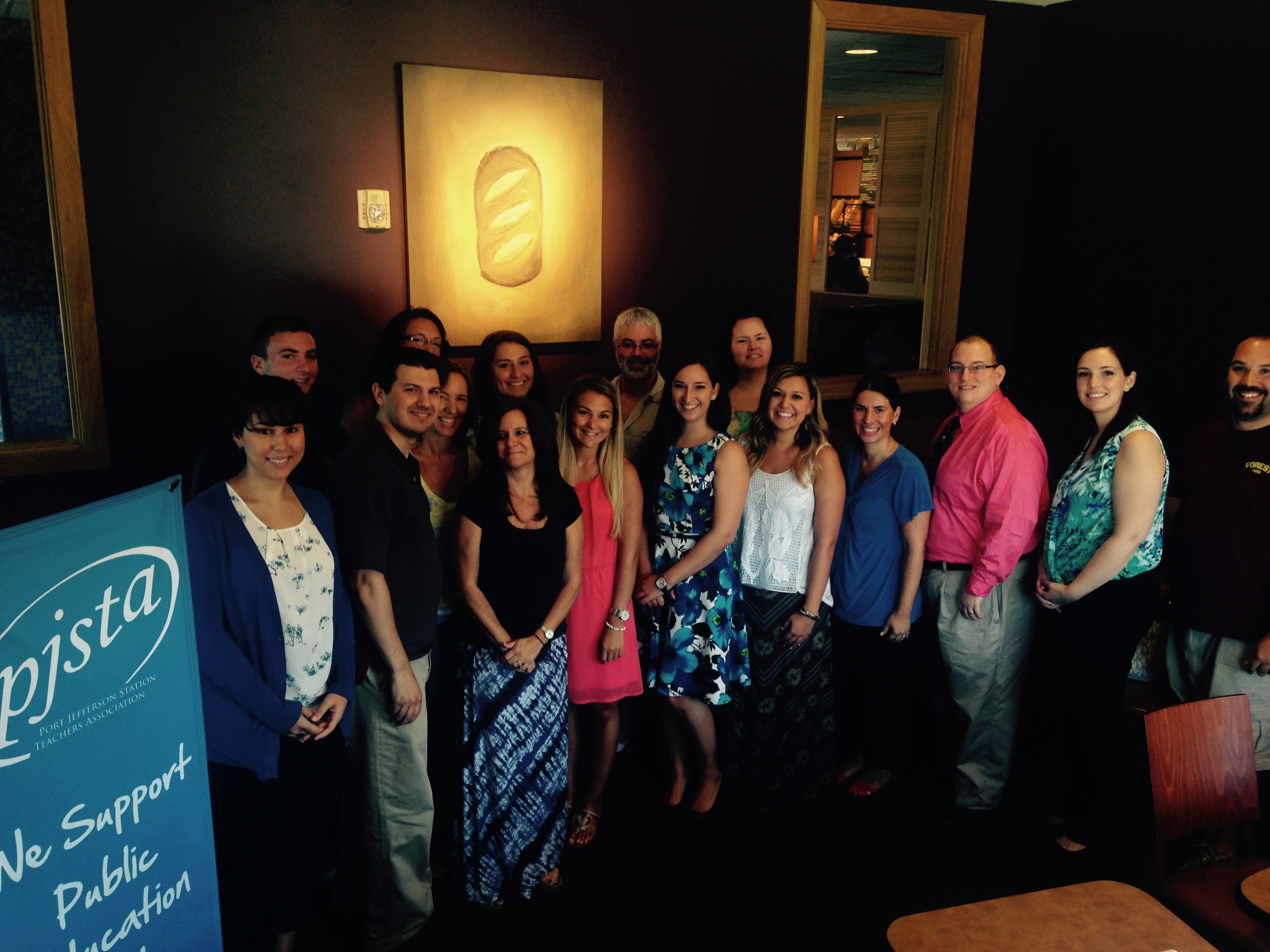
The newest members of the PJSTA!

Welcome to the newest members of the PJSTA!  Today, 18 new members had their orientation with members of the PJSTA’s executive board along with members of our rank and file.  In addition to taking care of membership paperwork and getting to know their contract, PJSTA’s newest members were briefed on the current landscape of public education in New York State and encouraged to get involved in being an activist who will advocate for their profession, their students, and the communities that we serve.

If you are a new PJSTA member, or someone else who is wondering where you can get informed and stay informed on all the happenings in public education, you will want to be sure to regularly check out the following…

Blogs

  • Perdido Street School- An brilliant blog, updated regularly, written by a NYC teacher who covers all things public education in New York.
  • NYC Educator– Updated nearly daily, another blog written by a NYC teacher, providing commentary on all the happenings in public education.
  • Diane Ravitch– The foremer Assisstant Secretary of Education keeps us up to date on public education in the US.
  • Ed Notes Online– Retired educator and long time activist Norm Scott’s well know blog dealing with public education and teacher unions.

Facebook Groups

Twitter

  • @ThePJSTA– The official Twitter account of The PJSTA
  • @beth_dimino– PJSTA President Beth Dimino
  • @sashammy– PJSTA 1st Vice-President Brian St. Pierre
  • @Refusethetests– PJSTA rank & file member, and dynamic public education activist Melissa McMullan
  • @STCaucus– The Rank & File Caucus of NYSUT
  • @nysape– New York State Allies for Public Education
  • @LIOptOut– Long Island Opt-Out
  • @perdidostschool– The Twitter account of the Perdido Street School blogger
  • @TeacherArthurG– The blogger who write the NYC Educator blog
  • @DianeRavitch– The aforementioned Diane Ravitch

This is by no means a comprehensive list, however it is a good list to get started with.  If you read these blogs several times a week and follow them on social media you are on your way to becoming an informed public school teacher in New York!