Ways to Support the CTU

ctustandsstrong-161

This morning we shared the PJSTA’s resolution in support of the Chicago Teachers Union, who are set to strike on Tuesday as they fight for the schools Chicago’s students deserve.

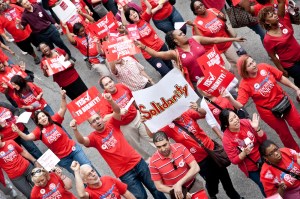
Next Tuesday, October 11th, we are asking all PJSTA members to wear RED as a show of solidarity and support for our brothers and sisters in the CTU.  Building reps will be coming around to take individual and group photos of our members in red.  You are welcome to make signs of support as well.  We will be sharing those pictures with members of the CTU via social media.

Here are a few more ways that you can support the CTU…

  • When information regarding a solidarity fund is available, be sure to contribute to it, while urging your colleagues to do so as well.  We will pass solidarity fund information along on this site once we get it.
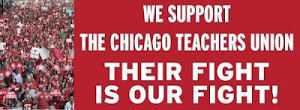
  • Be sure to talk to your fellow teachers about the strike.  Draw parallels between the situation in Chicago and the similar situations that can be found across New York State.  Help all of our NYSUT brothers and sisters to see that the CTU’s fight is our fight too!

To learn more details…

Go to the CTU site.

Check out this article from Labor Notes.

PJSTA Resolution in Support of the CTU

ctusupport

Passed unanimously by the Port Jefferson Station Teachers Association’s executive board…


WHEREAS the Chicago Teachers Union has been negotiating since 2014 for a just contract, and

WHEREAS Chicago students and teachers have faced attacks on public education that mirror those in New York State and around the country, and

WHEREAS Mayor Rahm Emanuel has threatened to eliminate city pension contributions for CTU members, which would effectively cut their pay by 7 percent, and

WHEREAS the CTU engaged in a successful strike in 2012, joining with parents, students, and communities to fight for educational justice and the schools Chicago’s students deserve, and

WHEREAS on September 28th, 95.6% of Chicago teachers voted to authorize a strike, and

WHEREAS, CTU has released a report, titled “A Just Chicago: Fighting for the City Our Students Deserve”, which, as the union puts it “demonstrates that challenges in housing, employment, justice and health care relate directly to education; solutions require a narrowing of the opportunity gap brought on by poverty, racism and segregation,” making CTU’s fight for a contract a touchstone for a wider struggle against austerity and for economic and racial justice, therefore be it

RESOLVED that the Port Jefferson Station Teachers Association supports the CTU in its fight to negotiate a contract that meets the needs of its members, their students, and their communities, and be it further

RESOLVED that the PJSTA will launch a solidarity campaign, to be shared via social media, in its schools and encourage all of its members to participate in the campaign as a show of support and solidarity with our sisters and brothers in Chicago, and be it further

RESOLVED that the PJSTA will urge its entire membership to wear red on Tuesday, October 11th in a show of solidarity with our brothers and sisters in the CTU, and be it further

RESOLVED that the PJSTA contribute to the CTU’s solidarity fund when information for such fund becomes available, and be it further

RESOLVED that the PJSTA share information with its general membership on how to contribute to the solidarity fund and urge each of its members to contribute individually as well, and be it further

RESOLVED that the PJSTA executive board engage the general membership in discussions on the strike, informing them of the issues involved and drawing parallels to the similar situations that impact educators in New York, and be it further

RESOLVED that the Port Jefferson Station Teachers Association urges NYSUT and its affiliates to adopt a similar resolution.

Chicago Teachers Union Headed for a Strike

Four years ago we covered the successful teachers strike in Chicago.  It looks like they are headed there again this fall.  You can take a look here at WBEZ in Chicago’s helpful graphic on the issues at stake along with the fuzzy math that the district is using to attack teachers with.

Also, I will re-post this article from our friends at Labor Notes.  It is written by CTU teacher Gabriel Sheridan, titled Chicago Teacher: Why We May Strike Again

Chicago teachers are voting September 21-23 on whether to authorize another open-ended strike.

I remember how worried I was as a rank-and-file teacher on the eve of the 2012 strike vote. I thought we’d never get a majority. The overwhelming yes vote by 90 percent of members came as a huge surprise to me—and gave us all extra motivation to unite on the picket line.

Later I learned that the activists and leaders who’d been organizing for the strike vote weren’t so surprised. Delegates were keeping in close touch, tracking our support in each school to make sure we got the 75 percent member vote that we would need to legally strike.

This time around, I’m one of the people reaching out to my co-workers and students’ parents to build support for a possible strike… though that doesn’t mean I’m not nervous.

Our contract has been expired for more than a year. We already voted by 88 percent in December to authorize a strike, and walked out for one day in April.

The union is holding this second vote partly to discourage any legal attacks from the mayor or governor over technicalities—and partly to solidify our solidarity.

PAY CUT DEMANDED

Union Allies

Our April 1 strike focused on more than just our contract. We spearheaded a citywide day of action with other unions and community groups—for instance, supporting organizing at O’Hare Airport and opposing the shutdown of a Nabisco plant.

All the local universities showed solidarity. Many are being hit hard with cuts. Chicago State University, where many African American teacher candidates get their credentials, is closing its doors. I spent half the day at CSU, and half protesting in Chicago’s downtown Loop.

And in August, we teamed up with Labor Notes and various local unions to host a Troublemakers School, where 250 rank-and-file activists attended organizing workshops and exchanged powerful stories.

A Verizon worker told how management couldn’t get the work done during their recent strike—because the bosses barely understand what workers do. A worker from the former Republic Windows and Doors factory described how they occupied their plant and won the right to buy out the company.

Organizing is hard work. But these inspiring stories reminded me how rewarding that work can be.

As usual, the newspapers and TV are parroting the mayor’s line that our pension is the cause of all of Chicago’s financial problems.

Mayor Rahm Emanuel claims he’s offering a 13 percent pay increase. But he wants to eliminate the district’s 7 percent payment toward our pensions, which he insists the city can’t afford.

This makes no sense, since the pension is actually part of our pay. Chicago teachers don’t get Social Security—those contributions are diverted into the district pension system. It’s all we have to retire on.

The city’s payment toward our pensions was originally set up as a stopgap measure at a time when the city was financially strapped. In exchange for accepting wage freezes, we were promised future pension payments. To demand that we pick up the pension cost now is a pay cut, and not a small one.

For years our union has been making the point that there’s plenty of money out there to fully fund our schools. That’s why we’re demanding a progressive tax in Illinois to make the wealthy pay their fair share, and demanding that the mayor fight to recover the money he’s lost to big banks in bad deals.

DOING MORE WITH LESS

Another constant storyline in the news is that teachers are overpaid and don’t work hard enough. But the truth is that teachers put in extraordinary amounts of time off the clock.

We’re in front of students from clock-in till clock-out, except for a one-hour prep period. That’s not nearly enough time to plan lessons, grade papers, and meet with parents. Just helping one student who comes in with a crisis can take up the whole hour.

So everyone comes early or stays late, unpaid. School starts at 8:45 a.m., but I arrive at 6:30 or 7. My colleagues and I meet straight through our unpaid lunch. And every night I haul home big bags of grading.

The pressures have only gotten worse as we’ve suffered wave after wave of layoffs and closings. The decline in the percentage of Black teachers has been stunning. This year the district closed and consolidated schools again, breaking its moratorium pledge. In August it announced 1,000 more layoffs.

Special education teachers, nurses, and social workers have been among those hit hardest. A high school with 1,400 students has just a half-time social worker. We’re fighting to get a librarian in every school, and gym class every day.

The same week the district announced the latest layoffs, it held a job fair. Administrators do their best to get around seniority rules so they can hire cheaper, inexperienced staff.

OVER-TESTED

Class size is another perennial problem. The district claimed it was closing underutilized schools, but now the displaced students are crowded in elsewhere. Meanwhile they’re pouring money into privately run charter schools, sometimes inside our own public school buildings.

All these issues are part of our union’s ongoing fight—though they’re not all issues we can legally bargain or strike over.

One issue we’re raising at the bargaining table is standardized testing. None of the private-school or charter-school kids have to endure such a battery of tests. We want contract language against over-testing.

So far, the city isn’t interested—though this is an area where our union proposals would actually save money. The tests are costly, both in required equipment and in teachers’ time. They tie up computers that could otherwise be available to students for coursework.

Meanwhile companies like Pearson are making a bundle developing the tests and selling the curricula and computer programs that go with them.

KNOCKING ON DOORS

So, here we are. The mayor says one thing, and the teachers say another. Parents don’t know what to believe.

Emanuel’s message that “teachers should have to contribute to the solution” can be confusing even for teachers. No one is immune to the media barrage, and not everyone went through the 2012 strike. In my school about a quarter of the teachers are new.

All summer long, the union has been working to clarify the facts. Young teachers in our organizing internship program have been out knocking on doors, engaging members in personal conversation to find out which issues affect them most.

On the doorsteps, members talk about unfair evaluation practices, poor building conditions, lack of supplies, the expansion of charter schools, privatization of custodial work, and inequity in the process for students to get into “selective enrollment” schools, further segregating our neighborhood schools.

These conversations are also a chance to educate each other. Some teachers don’t realize that our union fought for the resources we do have—like the right to basic supplies, computer access, even bathroom breaks.

TALKING TO PARENTS

We’re also making a push to talk personally with parents. If we do have to resort to a strike, parent involvement will be critical.

On a recent morning before I clocked in, I ran outside to pass out union flyers near the playground. You have to be off school grounds, so I stood on the sidewalk. Any parent who took the flyer, I engaged in a conversation.

Some were sweet and supportive. Others were skeptical, so I asked about their concerns—and when they heard about the issues we’re fighting for, they were receptive. The union is the only force standing up for what public education could be.

My next task as an organizer is to remember those parents’ names and keep the conversation going the next time I see them.

The Alliance to Save Our Schools—a joint effort by the two national teacher unions—has arranged its second National Walk-in Day on October 6. Across the country, teachers and parents will gather to celebrate public schools and then walk into school together.

At my school we’ve already held two walk-ins. Parents and teachers made brief speeches, and we even sang songs with the students. It felt powerful and loving, creating the sense that we’re all in this together.

The city has given Chicago’s working-class schools a bad reputation by underfunding them, segregating them, letting the paint peel off the walls. Schools in wealthier neighborhoods don’t suffer like that.

But despite everything that’s stacked against us, the schools in Chicago are good. Every day I see dedicated staff working to make a safe learning environment for kids. With better staffing and funding, just think what we could do!

Gabriel Sheridan teaches second grade. She has taught at Ray Elementary in Chicago for 19 years.
A version of this article appeared in Labor Notes #451, October 2016. Don’t miss an issue, subscribe today.

REMINDER: PJSTA shirts on Thursday!

Just a reminder to everybody that our opening conference day is on a Thursday, therefore it is expected all PJSTA members will be wearing a union shirt as we welcome each other back to school!

NYSUT’s VOTE-COPE “Campaign” Highlights What is Wrong with NYSUT

Two years ago, with NYSUT’s failure to oppose Governor Cuomo serving as “the straw that broke the camel’s back” PJSTA members followed the lead of their officers and stopped contributing to VOTE-COPE, the statewide union’s voluntary political action fund.  PJSTA President Beth Dimino has been vocal in describing her reasons for not contributing and this has drawn the ire of many Unity Caucus loyalists.  You’ll surely recall that last year Unity (the controlling caucus within NYSUT) used it’s blog to launch a personal attack at Dimino, labeling her “anti-union” among other things.

So this year NYSUT decided it’d try to step around Dimino in an attempt to solicit VOTE-COPE contributions from the PJSTA membership by sending out a form letter to each of our members asking for us to give to VOTE-COPE this year.  I want to be clear here… I do not have a problem with the leadership stepping around Ms. Dimino to approach our members about this.  The PJSTA membership made a strong statement about their confidence in NYSUT’s political action work when our members made their decisions to reduce their VOTE-COPE contributions to $0.  I would expect that to catch the attention of NYSUT leadership and I would expect them to want to contact those members about their decision.

The problem I have with their tactic comes in their chosen form of communication.  Nearly two full years after reducing our contributions, leadership’s response was to send each of our members a form letter.  There was no attempt to engage our members in discussion about our decision.  No reaching out to gauge our feelings on our statewide union, or to ask how they can better represent us.  No discussions about the broken union structures that lead to disengaged members.  No explanations for why they have generously donated to ed deformers like Andrew Cuomo and John Flanagan.  Just a simple form letter asking us to give them more money.  To be frank I found it insulting.  The idea that a form letter with all the usual rhetoric was going to suddenly sway me was simply astounding.

After reflecting on it, I think this incident really highlights some of the major problems with our statewide union.  Virtually all contact I have ever had with NYSUT is one-way communication where messages from the top are relayed down to me.  There is nearly zero back and forth.  No chance to engage our leaders in discussion about the state of our union.  No visits from the NYSUT officers to our schools to ask questions or to simply listen.  Sending form letters to request greater VOTE-COPE contributions is the very essence of top down unionism.  It’s ineffective, expensive, and does nothing to serve our members.

The fact that this happens is the result of of a broken union structure.  Andy Pallotta’s PAC work has resulted in teachers being held “accountable” via junk science through poorly constructed teacher evaluations over the past several years.  However there is no accountability for Andy Pallotta.  I am not sure whether or not STCaucus plans to run a slate in the coming NYSUT elections, but it doesn’t really matter.  Pallotta will run again for a NYSUT officer position again this spring and he will win.  This will likely be the case for a few of our other officers as well.  They are in a situation where they can’t lose because they will have the endorsement of the Unity Caucus.  In NYSUT’s rigged system of democracy the only thing that matters is the Unity endorsement.  The will of the members won’t matter.  The PJSTA membership’s VOTE-COPE reduction, which essentially amounted to a vote of no confidence in our leadership, won’t even be a blip on the radar when it comes to the election.

This is the type of stuff that turns people off to unions.  This is why it gets easy to become disengaged and apathetic.  I’ve had a lot of discussions about this sort of scenario with members across the state.  I’ll close with the gist of what I put in an email earlier today to one of those members about the only way I see to go forward and the only way that I can see transforming our union…

I think the way forward is to take our focus off of resolutions, leadership positions, and the NYSUT bureaucracy and focus solely on engaging and organizing the rank and file.  I think an engaged and active R&F will ultimately have a greater impact on the state’s public ed landscape than having a great leader at the top working within the same structure that has lead to a disengaged and apathetic membership to begin with.  By grassroots organizing you can ultimately increase your leadership capacity across the state and begin to cultivate local leaders who will challenge for leadership and delegate positions in areas that have traditionally been Unity strongholds (Syracuse, Rochester, Buffalo, Yonkers, UUP, PSC, etc.).  That is how you ultimately might win leadership positions within NYSUT.  More importantly, in the process, you will have organically grown an engaged, fighting union who is more powerful than we have ever knowN it to be.  It is a long slog for sure, with a tremendous number of obstacles in the way, and it requires the sort of person-to-person organizing that is neither glamorous or rapid in nature, but I believe it is the only way forward for us.